Stimulus Material

Visual judgment research on faces and person cues

Bastian J. Hirthammer · Email · DE | EN

Stimulus material

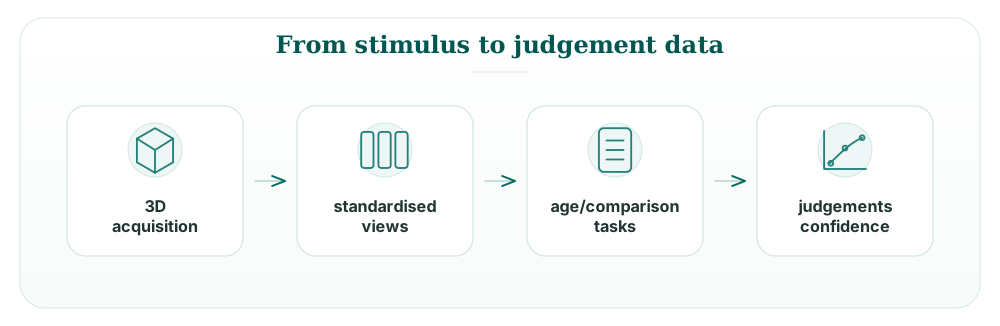
The stimulus material connects the origin, structure, and usability of existing 3D and image data. The focus is on controllable views as a basis for visual judgment tasks on age perception, facial comparison, confidence, and observer variability.

Why the material is relevant

The value of the material lies first in its research logic. Visible person cues can be presented in a controlled way and studied as the starting point of judgments. A technical 3D image base thus becomes a basis for questions about perception, cue weighting, confidence, and decision-making.

Age, view, surface structure, and image information can be linked to observer judgments, confidence, and judgment variability. The decisive bridge is between visible morphology and judgment quality: Which cues are present, which are perceived, and which actually enter a judgment?

This distinction is especially important for age judgments. Visible aging signs are not automatically unambiguous age cues. Age information can be central to face processing, but it remains dependent on which cues are visible, from which view they are seen, and how observers weight them.

The material work acknowledges that visible facial and person cues form a high-dimensional cue space and cannot be reduced to a small set of isolated features.

Stimulus pool

The key figures describe the working material at the material level. They are not result data; they show which views, age ranges, and technical information are available for later observer tasks.

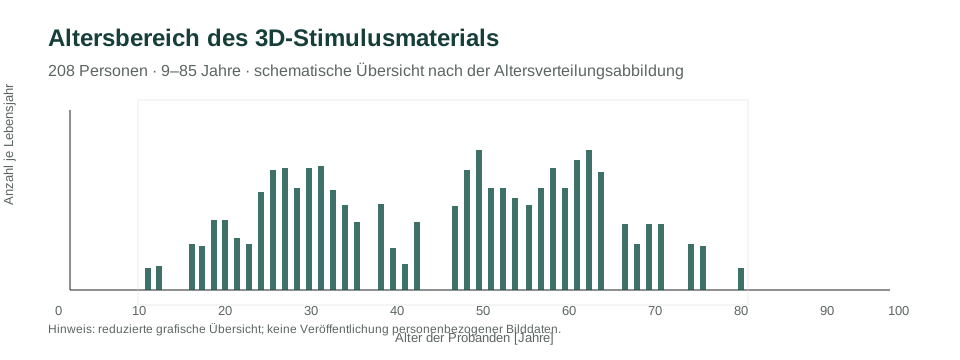
The stimulus pool currently used for research questions comprises 208 persons aged 9 to 85 years. The original 3D acquisition documented 210 digitized heads; the currently usable pool was curated from this basis.

For each person, three 3D scans of the head were acquired: one frontal scan and one lateral scan from the left and from the right. The current raw material therefore comprises 624 position-specific 3D single scans.

Multiple views of the same person are not merely additional material. They make visible which cues remain stable across perspectives and which vary through view, surface, or representation.

The acquisition was performed with a non-contact VI-910 3D laser scanner. At the same time, texture and image information were documented via the integrated digital camera. Standardized frontal and lateral views for observer studies can be derived from these data.

208currently usable persons
210originally digitized heads
9–85years
3 × 208frontal and lateral 3D scans
624position-specific single scans
307,200measurement points per scan
2.5 sscan time per position
Methodological value: The controllability makes the pool particularly useful. Frontal and lateral views can be considered separately or in combination; perspective and visible image information can be varied without changing the underlying person. This makes the distinction between stable cues and view-dependent variation empirically accessible.

Age distribution

The base material covers a broad age range from childhood and adolescence through adulthood to higher age groups. The stimulus pool is therefore suitable not only for isolated age comparisons, but also for questions of visual age perception across a large part of the lifespan.

Schematic age distribution of the 3D stimulus material
Schematic overview of the age range represented in the 3D stimulus material.

Origin of the material

The data basis originated from 3D acquisitions conducted since 2005 to study visible head and face cues. The aim was the 3D-supported quantification of visible aging cues and the question of how age-related changes can be described and compared.

The material basis was established within a scientific study using written consent, purpose-bound non-commercial use, encrypted storage, and protection of participant anonymity.

The original acquisition was not merely a technical digitization. It was connected to image documents from earlier life periods. The material thus links 3D-based documentation of visible person cues, visible aging cues, and the later question of how such cues are perceived, weighted, and judged under uncertainty.

Experimental usability

The material is suitable for observer studies on age judgments, facial comparison, cue weighting, confidence, and observer variability. It is not tied to a single study design, but can support different judgment tasks.

The available views make information use, decision thresholds, and judgment quality empirically accessible. Visible cues can be treated as stimulus information and related to observer judgments.

3D acquisition and technical basis

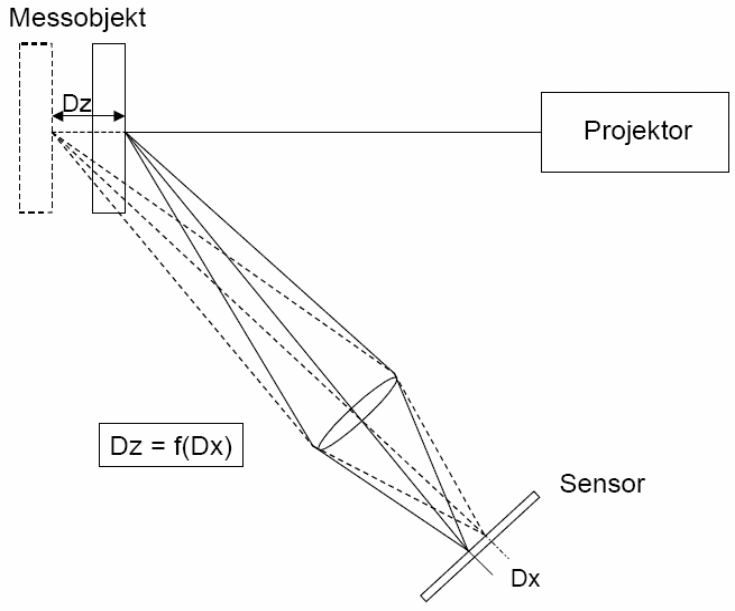
The data were acquired with a non-contact 3D laser scanner based on laser triangulation. The scanner does not detect cues in an interpretive sense. It records a dense laser point cloud of the object surface. These points are vector-based and subsequently combined with photographic RGB information. This creates a geometrically controllable surface model with corresponding texture information.

Each scan captured 640 × 480 measurement values, corresponding to 307,200 measurement points. The original technical documentation reports a measurement accuracy of ±0.010 mm at one sigma and a geometric resolution of 0.008 mm in the z-coordinate.

The scan itself took 2.5 seconds per position. Digitizing one person took about 10 minutes in total. For each head, three scans were acquired: lateral left, frontal, and lateral right. The individual scans could subsequently be combined into an overall acquisition.

The acquisition setting was designed for reproducible conditions. Participants sat on a freely rotating but fixed chair. The focus distance was 1060 mm for the frontal scan and 920 mm for the lateral scans.
Lighting was kept constant using fluorescent tubes; external light sources were reduced by darkening the room. To stabilize gaze direction, a fixation point was placed at eye level.

For later observer studies, this standardization is not only technical documentation. It is a prerequisite for analytically separating differences attributable to stimulus, view, and observer.

ScannerKonica Minolta VI-910
MethodNon-contact laser triangulation
Values per scan640 × 480 = 307,200 points
Raw material3 × 208 = 624 position-specific 3D scans
Accuracy±0.010 mm at 1 sigma
Z-resolution0.008 mm
Scan time2.5 seconds per position
Positionslateral left · frontal · lateral right
Focus1060 mm frontal · 920 mm lateral
TextureRGB, 24-bit color depth
Principle of a triangulation sensor
Principle of laser triangulation used for 3D acquisition.

Documentation of the 3D workflow

The following figures show the technical context of 3D acquisition and subsequent digital processing. They illustrate the material and methodological foundation; person-related stimuli are not publicly displayed.

Morphological prior work

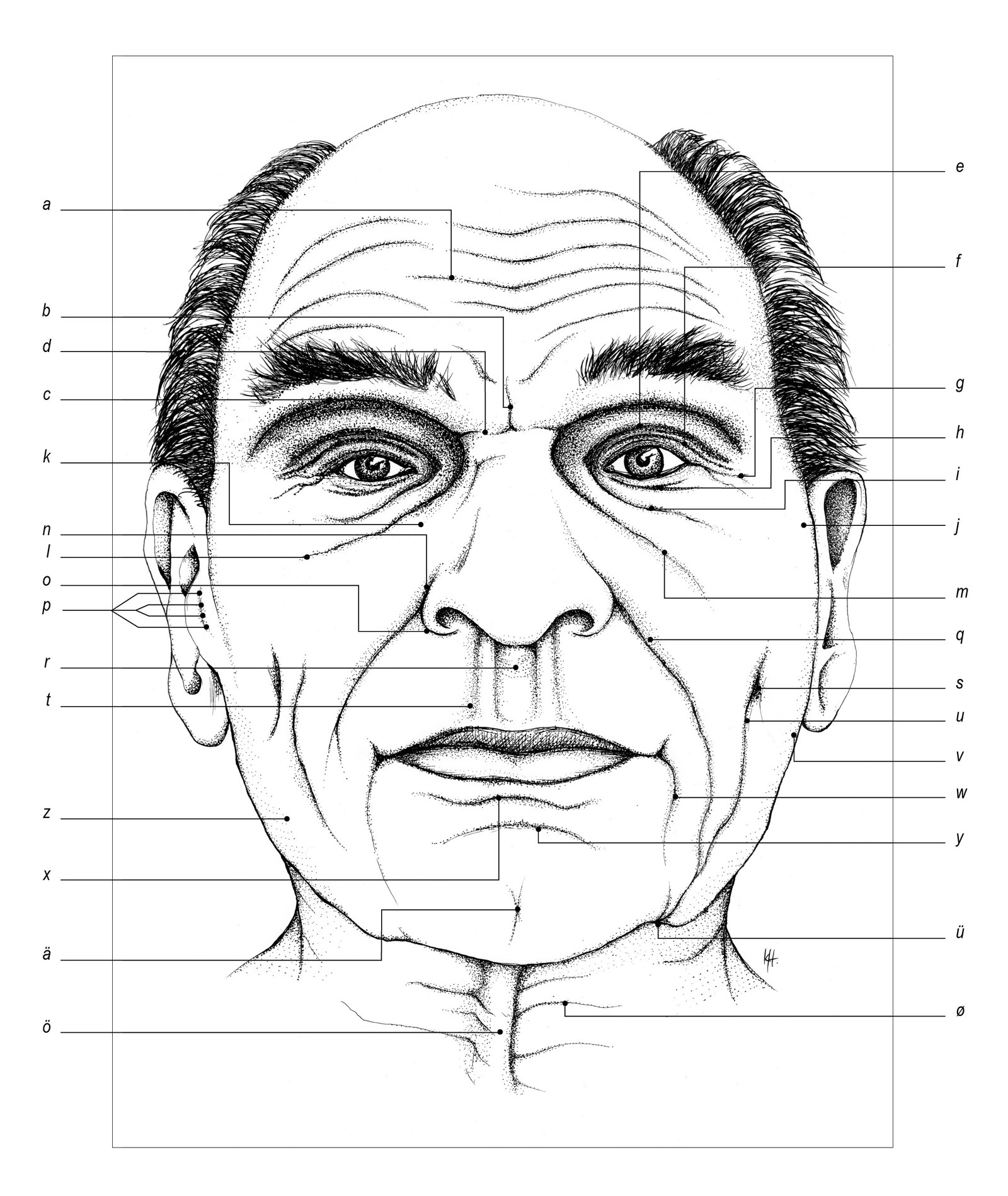
Earlier work addressed the systematic description of visible aging signs, especially visible wrinkle, furrow, line, and pit structures.

Furrows were described as elongated depressions of the skin, wrinkles as elevations between furrows, pits as depressions without longitudinal extension, and lines as age-related crease structures.

These morphological prior works form a starting point for questions: Which aging cues are perceived? How are they weighted? Which cues are reliably assessable under specific image conditions?

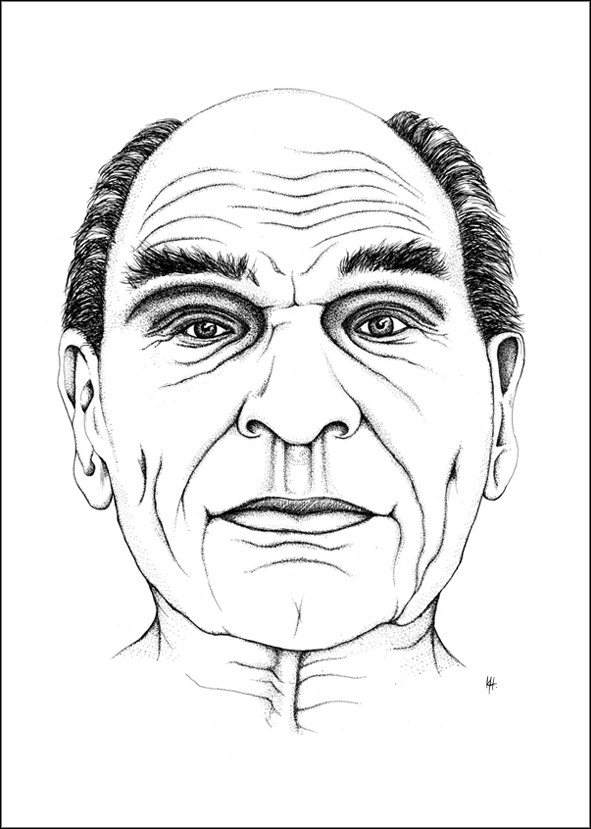
Labeled overview of aging-related wrinkles, furrows, lines and pits
Labeled schematic overview of aging-related wrinkle, furrow, line, and pit structures. The figure serves as morphological orientation, not as a full current coding system.

The prior work included not only a frontal representation, but also lateral and oblique isometric views. This shows that aging-related facial structures are perceived in a view-dependent way and that perspective, contour, skin relief, and soft-tissue form cannot be separated for visual judgments.

Legend of the schematic overview
a

Lineae frontales transversae — horizontal forehead lines

b

Lineae glabellares verticales — vertical glabellar lines

c

Sulcus orbitalis superior — superior orbital furrow

d

Sulcus nasalis transversus — nasal root furrow

e

Sulcus anonymus superior — upper lid fold transition furrow

f

Sulcus orbito-palpebralis superior — upper eyelid furrow

g

Lineae canthi lateralis — lateral canthus lines

h

Sulcus orbito-palpebralis inferior — lower eyelid furrow

i

Sulcus anonymus inferior — canthal furrow

j

Lineae orbitales laterales — temporal orbital lines

k

Plica naso malaris — naso-malar fold

l

Sulcus orbitalis inferior — inferior orbital furrow

m

Sulcus oculo-malaris — oculo-malar furrow

n

Sulcus alaris superior — superior alar furrow

o

Sulcus alaris inferior — inferior alar furrow

p1

Lineae tragici superiores — upper tragus lines

p2

Lineae tragici mediae — middle tragus lines

p3

Lineae tragici inferiores — lower tragus lines

p4

Lineae tragici accessoriae — accessory tragus lines

q

Sulcus nasolabialis — nasolabial furrow

r

Sulcus nasooralis — philtral / naso-oral groove

s

Fovea buccalis — buccal pit

t

Lineae supralabiales — supralabial lines

u

Sulcus mento-malaris — mento-malar furrow

v

Lineae retroauriculares — retroauricular lines

w

Sulcus angularis — mouth-angle furrow

x

Sulcus sublabialis — sublabial furrow

y

Sulcus mentolabialis — mentolabial furrow

z

Plica mento malaris — mento-malar fold

ä

Fovea mentalis — mental pit

ö

Plica verticalis menti — vertical neck fold

ü

Sulcus transversus menti — submental transverse furrow

ø

Lineae cervicales — horizontal neck lines

The legend is provided as morphological orientation. It describes the wrinkle, furrow, line, and pit structures labelled in the figure without defining a current scoring scheme or a complete marker logic.

File formats and further processing

After acquisition, geometric surface data and photographic texture data were combined. The object surface was modeled from the laser point cloud in the object coordinate system; the RGB images could then be transferred onto this surface. Several 3D and exchange formats were available for further processing.

Protection of the material

The stimulus material is described only in general form. Person-related image data, individual case data, and unpublished analysis details are not publicly displayed.